
Discover the full month-by-month hair transplant growth process. Learn what to expect from recovery, shock loss, to final 12-month results.
Hair Transplant Results: How Long Does It Take to See the Final Outcome?
One of the first questions people ask before undergoing a hair transplant is also one of the most natural:
When will I actually see my new hair?
After investing time and effort in a hair restoration procedure, it is understandable to want to see a visible change as quickly as possible. However, a hair transplant does not produce its final result immediately after surgery.
The scalp needs time to heal, the transplanted follicles need to adapt to their new environment, and the natural hair growth cycle must continue.
This is why the first weeks and months can sometimes look very different from the final result.
In the early period, redness, swelling and small crusts can appear around the transplanted follicles. The visible hair shafts may then shed temporarily. This stage is commonly known as shock loss, and it can make the hair appear thinner before new growth begins.
The first signs of new growth usually become more noticeable during the following months. The hair then gradually becomes longer, thicker and easier to style.
According to the American Academy of Dermatology, most patients begin to see noticeable results around six to nine months after surgery, although some people may need up to 12 months.
The important point is that every patient has an individual growth timeline.
In this guide, we explain what you can generally expect after a hair transplant, from the first days through the first year and beyond.
What Happens After a Hair Transplant?
A hair transplant involves moving healthy hair follicles from a donor area, usually located at the back or sides of the scalp, to areas affected by thinning or hair loss.
The procedure itself is only the beginning of the restoration process.
Once the follicles have been implanted, the scalp needs to recover. The transplanted follicles also need to establish themselves in their new location before producing new visible hair.
This explains why the appearance of the scalp immediately after surgery cannot be used to predict the final result.
During the first days, the scalp may look red or slightly swollen. Small crusts can form around the implanted grafts as part of the normal healing process.
The transplanted hair shafts may subsequently fall out.
This can be surprising, especially for someone who expects the newly implanted hairs to continue growing without interruption.
However, temporary shedding does not necessarily mean that the transplant has failed. The visible hair shaft and the follicle underneath the skin are not the same thing.
The follicle can remain in place while the visible shaft sheds before a new growth cycle begins.
This is one of the main reasons why patience is essential after a hair transplant.
Hair Transplant Results Month by Month
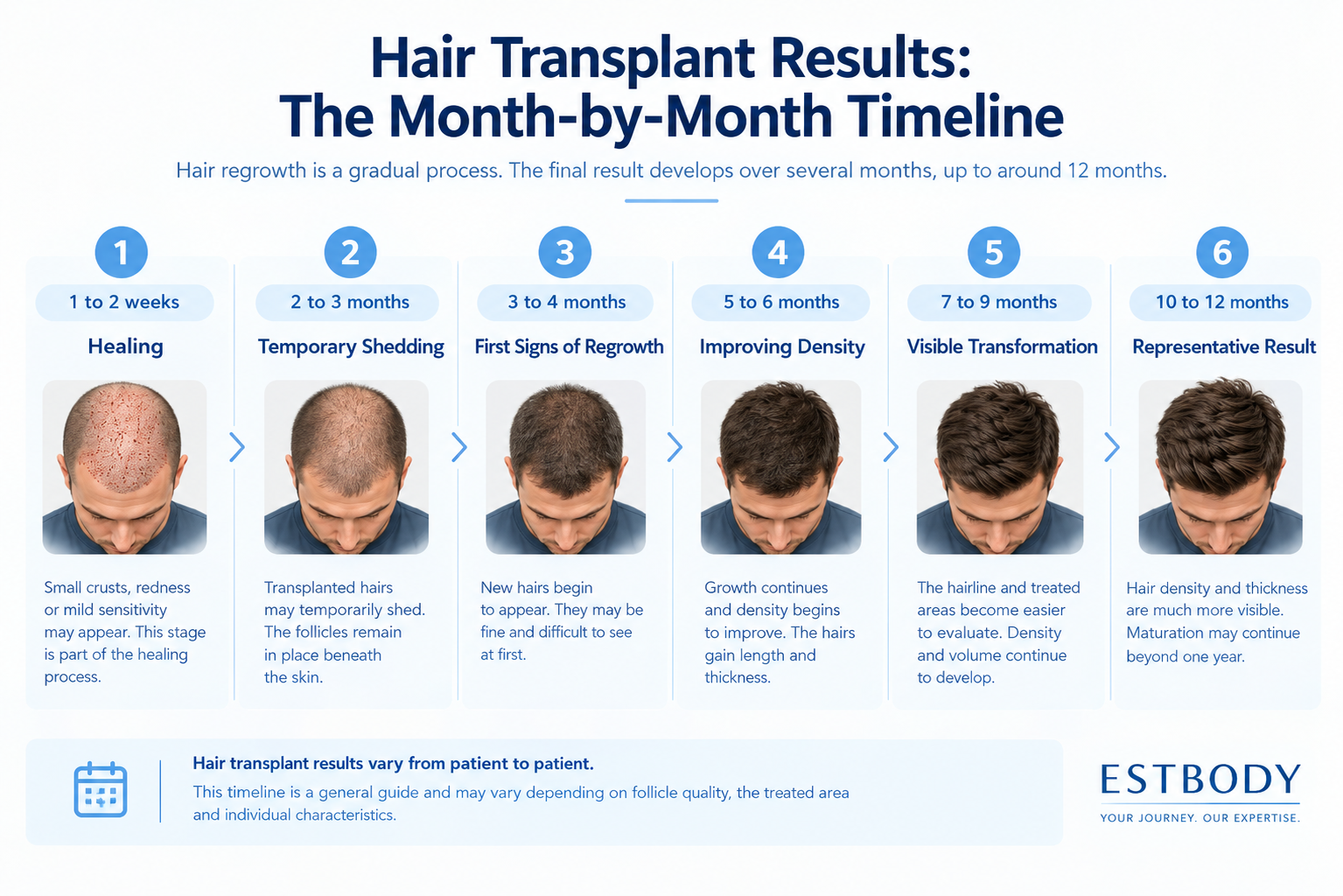
The following timeline provides a general overview of what many patients experience after hair transplantation.
It should not be treated as a strict calendar.
Hair growth varies from person to person depending on factors such as the individual hair cycle, the characteristics of the transplanted follicles, the treatment area, the quality of the donor area and the patient's healing process.
Days 1–14: Healing and Graft Recovery
The first two weeks are mainly focused on protecting the scalp and allowing the transplanted area to recover.
Redness, sensitivity, swelling and small crusts can occur during this stage.
The scalp may not look the way you expected, but this is not the right time to evaluate the density or final appearance.
Following the postoperative instructions provided by your medical team is particularly important during this period.
Washing, drying, sleeping position, physical activity and sun exposure should all be managed according to the instructions you receive after your procedure.
As healing progresses, the crusts gradually disappear and the scalp begins to return to a more normal appearance.
The main objective during these first two weeks is not hair growth.
It is proper healing and protection of the transplanted area.
Weeks 2–8: Temporary Hair Shedding and Shock Loss
The second phase can be psychologically challenging.
Some or many of the transplanted hair shafts may begin to shed during this period. The hair can therefore look thinner than it did shortly after surgery.
This phenomenon is commonly referred to as shock loss or temporary shedding.
The American Academy of Dermatology notes that transplanted hair can fall out between two and eight weeks after surgery and that the hair may look thinner around the third month. This does not automatically mean that the procedure has failed.
The important distinction is between the visible hair shaft and the follicle.
The shaft may fall out while the follicle remains in the scalp and enters another stage of its natural growth cycle.
For patients who are closely monitoring their hair every day, this phase can create unnecessary concern.
A transplant should not be judged based on its appearance during the shedding stage.
Months 2–3: The Waiting Period
By the second and third months, some patients may feel that very little is happening.
The transplanted area may still look relatively sparse, and in some cases it may appear thinner than it did immediately after the procedure.
This can be frustrating, but it is part of the process for many patients.
The follicles are going through their natural cycle before producing new visible hair.
At this point, comparing your appearance with photographs taken immediately after surgery can be misleading.
The early postoperative appearance does not represent the final density.
Instead of looking for dramatic changes every few days, it is more useful to document your progress over longer intervals.
Monthly photographs taken under similar lighting and from similar angles can provide a much clearer picture of the evolution.
Months 3–4: First Signs of New Hair Growth
Around the third or fourth month, some patients begin to notice the first signs of new growth.
The initial hairs can be very fine, short and light.
They may also look different from the surrounding natural hair.
Growth can appear uneven at first. One area may begin producing visible hairs while another area appears to be progressing more slowly.
This does not necessarily indicate a problem.
Hair follicles do not all enter the growth phase at exactly the same time.
The new hairs gradually become longer and thicker as the growth cycle continues.
For many patients, this is the moment when the first visible signs of the transformation begin to appear.
However, there is still a long way to go before the final result can be assessed.
Months 5–6: Visible Hair Growth and Increasing Density
Between months five and six, the changes often become easier to see.
New hairs continue to grow and gradually become more substantial.
The transplanted area can start to look fuller, and the hairline may become more defined.
For some patients, this is the stage when the difference between the pre-transplant appearance and the current appearance becomes much easier to appreciate.
However, the result is still developing.
The hairs can continue to increase in length and thickness over the following months.
It is therefore important not to compare your progress with another patient's five- or six-month result and assume that your own hair should look exactly the same.
Two patients can undergo similar procedures and experience different growth patterns.
Months 7–9: A More Noticeable Transformation
Between months seven and nine, the overall transformation can become significantly easier to evaluate.
The transplanted hairs have had more time to grow, and the difference in density can become increasingly visible.
The hair can also become easier to comb and style.
At this stage, before-and-after photographs can be particularly useful because the comparison covers a meaningful period of growth.
Nevertheless, photographs should always be taken under similar conditions.
Lighting, camera angle, hair length and styling can dramatically change the apparent density of the scalp.
The result is still not necessarily completely mature at this point.
Some patients continue to experience further thickening during the following months.
Months 10–12: A Representative Result
Around the tenth to twelfth month, many patients have a much clearer picture of their result.
The transplanted hair has had considerably more time to grow, thicken and integrate visually with the existing hair.
For many people, this period provides a representative view of the outcome.
However, the twelfth month should not be treated as an identical deadline for everyone.
Some patients continue to see gradual changes after the first year, particularly in terms of hair thickness and overall maturation.
The crown area can also develop more slowly than some other parts of the scalp.
For this reason, the final evaluation should take the individual's treatment area and growth pattern into account rather than relying on a single calendar date.
Why Is Hair Transplant Growth Not Immediate?
The answer lies in the natural biology of hair follicles.
A hair transplant moves follicles from one area of the scalp to another. The follicles then need to adapt to their new environment and continue through their natural growth cycle.
The visible hair does not necessarily remain continuously attached to the follicle throughout this process.
A transplanted hair can therefore shed before the follicle produces a new hair.
This is why the immediate appearance after surgery is not a reliable indicator of the final result.
Hair restoration is a biological process rather than an instant cosmetic change.
The procedure places the follicles where they are needed.
Time is then required for those follicles to produce visible, mature hair.
Is It Normal to Lose Hair After a Hair Transplant?
Yes.
Temporary shedding can occur after hair transplantation and is often referred to as shock loss.
For a patient, it can be alarming to see transplanted hairs falling out after undergoing the procedure.
However, the loss of the visible hair shaft does not necessarily mean the follicle has been lost.
The follicle can remain beneath the scalp and later produce new growth.
In some situations, existing non-transplanted hairs around the treated area can also experience temporary shedding.
This is another reason why the first few months should not be used to judge the final density.
If you are concerned about significant or unusual shedding, the appropriate step is to contact the medical team responsible for your postoperative care.
FUE vs DHI: Does the Technique Change the Growth Timeline?
FUE and DHI are two techniques used in modern hair transplantation, but the choice of technique alone does not determine exactly when a patient will see the final result.
FUE Hair Transplant
FUE, or Follicular Unit Extraction, involves extracting individual follicular units from the donor area before implanting them into the recipient area.
The method is widely used in hair restoration and allows follicles to be harvested individually rather than removing a linear strip of scalp.
The recovery and growth process still depends on the individual characteristics of the patient and the transplanted follicles.
DHI Hair Transplant
DHI, or Direct Hair Implantation, uses a specific implantation approach for placing follicles into the recipient area.
The technique can be selected according to the patient's hair loss pattern, donor area, desired design and medical assessment.
At Estbody, different hair transplantation approaches are considered according to the patient's individual situation rather than applying exactly the same method to everyone.
Does DHI Grow Faster Than FUE?
It is better not to judge the expected growth timeline solely by whether FUE or DHI was used.
Hair growth depends on multiple biological and individual factors.
The technique is important, but so are the condition of the donor area, follicular characteristics, recipient area, postoperative care and the patient's natural growth cycle.
The appropriate technique should therefore be selected as part of an individualized treatment plan.
Hair Transplant Before and After: How Should You Read the Photos?
Before-and-after photographs are one of the most common ways to evaluate hair transplant results.
They can be useful, but they need to be interpreted carefully.
Compare Similar Angles
Ideally, photographs should be taken from the same angle before and after treatment.
The frontal view, side views, top view and crown should be photographed consistently.
A different angle can make the hair appear significantly denser or thinner even when no actual change has occurred.
Keep the Lighting Similar
Lighting has a major effect on how the scalp and hair appear.
Strong overhead lighting can make the scalp more visible, while softer lighting can create the impression of greater density.
For a meaningful comparison, try to use similar lighting conditions.
Hair Length Also Matters
Short hair and longer hair can create very different visual impressions.
If one photograph shows very short hair and another shows considerably longer hair, it becomes more difficult to compare density directly.
Consider the Time Between Photographs
A three-month photograph should not be interpreted in the same way as a twelve-month photograph.
The growth process is still developing during the first several months.
A before-and-after comparison becomes more informative when the follow-up photograph corresponds to a meaningful stage of the growth cycle.
Every Patient Has an Individual Result
Two patients receiving a similar number of grafts can still have different visual outcomes.
Hair diameter, texture, donor density, skin-to-hair contrast and the natural characteristics of the patient's hair can all influence how dense the final result appears.
Before-and-after photographs should therefore be used to understand possible outcomes rather than as a guarantee of an identical result.
Hair Transplant in Istanbul: Why Follow-Up Matters
Choosing to have a hair transplant in Istanbul means that the procedure is only one part of the overall journey.
Postoperative follow-up is also important, particularly for international patients who return home shortly after treatment.
During the first weeks and months, patients may have questions such as:
-
Is this amount of redness normal?
-
When can I return to exercise?
-
Why are my transplanted hairs falling out?
-
When can I wash my hair normally?
-
Can I wear a hat?
-
Why does one area seem to be growing faster than another?
-
When should I expect visible density?
-
Is my progress normal?
A structured follow-up can help place these changes in context.
Estbody provides personalized support throughout the hair transplant process, including pre-treatment assessment and postoperative monitoring.
If you are considering a hair transplant in Turkey, you can learn more about the treatment process and patient journey on our dedicated page:
How Much Does a Hair Transplant in Turkey Cost?
The cost of a hair transplant can vary depending on several factors.
The number of grafts required, the treatment area, the technique selected, the medical facilities involved and the services included in the treatment package can all influence the overall price.
Estbody publishes different price ranges for hair transplantation and techniques such as FUE and DHI, but the appropriate treatment plan depends on an individual assessment.
For this reason, price should not be the only factor considered when comparing hair transplant options.
It can also be useful to consider:
-
The medical assessment before treatment
-
The experience and qualifications of the medical team
-
The technique proposed
-
The condition of the donor area
-
The quality of the clinic and facilities
-
Postoperative follow-up
-
What is included in the treatment package
-
The overall patient journey before and after surgery
A lower advertised price does not necessarily represent the same service or treatment plan as another clinic.
How Can You Support a Good Recovery After a Hair Transplant?
Recovery is not based on a single action.
It involves following the postoperative instructions provided by the medical team and giving the scalp enough time to heal.
Follow the Recommended Washing Routine
The scalp should be washed according to the instructions provided after the procedure.
During the initial healing period, aggressive rubbing or scratching should be avoided.
Avoid Unnecessary Touching
The transplanted area should be handled gently.
Scratching, rubbing or pulling at the scalp can irritate the healing skin.
Return to Exercise Gradually
Physical activity can usually be resumed progressively, but the timing depends on the procedure and the instructions given by the medical team.
Intense exercise, swimming, sauna use and activities that produce significant sweating may require additional precautions during the early recovery period.
Protect the Scalp From Excessive Sun Exposure
The scalp can remain sensitive after surgery.
Follow your clinic's recommendations regarding sun exposure and scalp protection, particularly while the skin is still healing.
Follow Your Medical Team's Instructions
Online information can provide general guidance, but your own medical team's postoperative instructions should take priority because they are based on your specific procedure and recovery.
Why Should You Avoid Judging Your Hair Transplant Too Early?
One of the most common sources of anxiety after a hair transplant is checking the scalp every day and looking for immediate changes.
Hair growth is too gradual to be accurately assessed over a few days.
A photograph taken today may look almost identical to one taken a week earlier even though the follicles are progressing through important biological stages.
Instead of focusing on daily changes, it is more useful to monitor your progress over several months.
Taking photographs at regular intervals can help you see changes that may be difficult to notice when looking at yourself in the mirror every day.
The first few months can be particularly misleading because temporary shedding and fine new hairs can make the scalp look very different from the eventual result.
What Factors Can Affect Hair Transplant Results?
The final appearance of a hair transplant does not depend solely on the number of grafts implanted.
Several factors can influence the outcome.
The Donor Area
The donor area provides the follicles used during transplantation.
Its density and the quality of the available hair therefore play an important role in treatment planning.
Before surgery, the donor area should be evaluated to determine how many follicles can reasonably be used while maintaining an appropriate appearance.
Hair Thickness and Texture
Hair diameter can strongly influence the visual impression of density.
Two people with a similar number of transplanted follicles may not have identical-looking results if their hair characteristics are different.
Thicker hair can provide more visual coverage, while finer hair may require a different approach to achieve a similar appearance.
The Treatment Area
The frontal hairline, temples, mid-scalp and crown can require different planning.
The amount of available donor hair must be considered in relation to the areas that need restoration.
A personalized hairline design and graft distribution are therefore important parts of treatment planning.
Existing Hair Loss
A hair transplant restores follicles to selected areas, but it does not necessarily stop natural hair loss in non-transplanted areas.
This is an important consideration when planning long-term hair restoration.
The current pattern of hair loss and its potential progression should be assessed before deciding on the treatment strategy.
Postoperative Care
Following the recommended aftercare instructions can help support the recovery process.
Washing, physical activity, sun exposure and scalp handling should be managed according to the medical team's instructions.
What If Hair Growth Seems Slow After Several Months?
A slower-looking growth pattern does not automatically mean that a hair transplant has failed.
Hair grows at different rates in different people.
Some patients notice visible changes relatively early, while others need more time before the transformation becomes obvious.
The appearance of the hair can also change significantly between months three, six, nine and twelve.
If your progress concerns you, the best approach is to contact the team responsible for your postoperative care.
The medical team can assess photographs, examine the scalp when appropriate and determine whether the progress is consistent with the expected recovery process.
It is not advisable to change medication or add products marketed as hair-growth accelerators without discussing them with a qualified medical professional.
When Can You Consider a Hair Transplant Result Mature?
There is no single date that applies perfectly to every patient.
For many people, the result becomes substantially more visible between six and nine months. Some patients may need up to twelve months, while further maturation can continue beyond the first year.
The exact timeline depends on the individual.
The transplanted hairs need time to grow in length, develop their mature appearance and blend with the surrounding hair.
The crown can also take longer to develop visually than some frontal areas.
This means that a patient should not automatically assume that a slower crown response represents a poor result.
A proper evaluation should consider the treatment area, the starting point, the number of grafts, the donor area and the patient's individual growth pattern.
Planning a Hair Transplant in Turkey: What Should You Consider?
Turkey, and particularly Istanbul, has become a major destination for international hair transplant patients.
However, planning a hair transplant should involve more than comparing package prices or choosing a travel date.
Before treatment, it is useful to understand:
-
The pattern and likely cause of your hair loss
-
The condition of your donor area
-
Which areas require restoration
-
The approximate number of grafts needed
-
Which technique may be appropriate
-
How the procedure is performed
-
What happens during the first days after surgery
-
What postoperative care is required
-
How follow-up is managed after returning home
-
How long the growth process may take
Estbody provides personalized assessment and support throughout the treatment journey in Istanbul.
For more information about the procedure, recovery and patient journey, visit:
When Should You Contact Your Medical Team?
A gradual recovery is expected after hair transplantation, but some symptoms should be discussed with a healthcare professional.
Contact your medical team if you experience:
-
Severe or unusual pain
-
Increasing redness
-
Significant or persistent swelling
-
Unusual discharge
-
Fever
-
Significant bleeding
-
A sudden change that concerns you
-
Any symptom that appears to be getting worse rather than improving
Do not try to diagnose a possible complication solely from information found online.
Your own medical team's instructions should remain the primary reference because they are based on your individual procedure and recovery.
FAQ: Hair Transplant Results Month by Month
When does hair start growing after a hair transplant?
Visible regrowth generally develops gradually after the initial recovery and shedding phases. Some patients begin to notice new hairs around months three or four, although the exact timing varies.
Is it normal for transplanted hair to fall out?
Yes. Temporary shedding can occur during the first weeks after a transplant. The visible hair shaft may fall while the follicle remains in the scalp and later produces new growth.
When will I see the final hair transplant result?
Many patients see significant results between six and nine months, while some may need up to twelve months. Further maturation can sometimes continue beyond the first year.
What should my hair look like after three months?
Three months can still be an early stage of the regrowth process. Some patients may begin to see fine new hairs, while others may still have relatively little visible change.
Why does my hair look thinner after the transplant?
Temporary shedding can make the transplanted area look thinner during the early months. This does not necessarily indicate that the transplant has failed.
Can FUE and DHI have different growth timelines?
The growth timeline cannot be determined solely by whether FUE or DHI was used. Individual biology, follicular characteristics, treatment area and postoperative care all contribute to the growth process.
Can I make my transplanted hair grow faster?
There is no guaranteed method that can immediately accelerate the biological growth cycle. Following postoperative instructions, maintaining appropriate general health and discussing any additional treatment with your medical team are more appropriate approaches.
When can I wash my hair normally after a hair transplant?
Your clinic should provide specific washing instructions for the initial recovery period. The timing can vary according to the procedure and the condition of the scalp, so the instructions from your medical team should be followed.
Can I wear a hat after a hair transplant?
The timing depends on the type of hat, the procedure and your clinic's instructions. Avoid putting unnecessary pressure or friction on the transplanted area during the early healing period.
Does the crown take longer to grow?
The crown can appear to develop more slowly in some patients. The growth pattern varies between individuals, so a slower-looking crown does not automatically indicate a problem.
Can transplanted hair fall out permanently?
Temporary shedding of transplanted hair shafts can occur. However, persistent concerns about significant hair loss should be discussed with the medical team so that the scalp and growth process can be properly assessed.
Can natural hair continue to thin after a hair transplant?
Yes. A hair transplant moves follicles into areas affected by hair loss, but non-transplanted hair can continue to thin over time. Depending on the individual situation, a doctor may discuss medical treatments that can help slow ongoing hair loss.
When should I contact my clinic after a hair transplant?
Contact your medical team if you develop severe pain, worsening redness, significant swelling, fever, unusual discharge, significant bleeding or any other symptom that concerns you.
The Hair Transplant Journey Takes Time
A hair transplant should be viewed as a gradual restoration process rather than an immediate cosmetic transformation.
The first days are mainly focused on healing. During the following weeks, temporary shedding can occur. Around the third and fourth months, some patients begin to notice the first signs of new growth.
The transformation generally becomes more visible during the following months, with many patients seeing significant changes around six to nine months. Some people require longer for the result to mature, and further changes can continue around the one-year mark and beyond.
The most important thing is to understand that hair transplant results develop progressively.
Your starting point, donor area, hair characteristics, treatment area and natural growth cycle all contribute to the final appearance.
If you are considering a hair transplant in Istanbul or Turkey, Estbody can help you understand your individual situation, evaluate your hair loss and plan the next steps of your treatment journey.
Learn more about our Hair Transplant in Turkey services and discover what you can expect before, during and after your procedure.
Give your hair the time it needs to grow. The most meaningful changes happen gradually.