
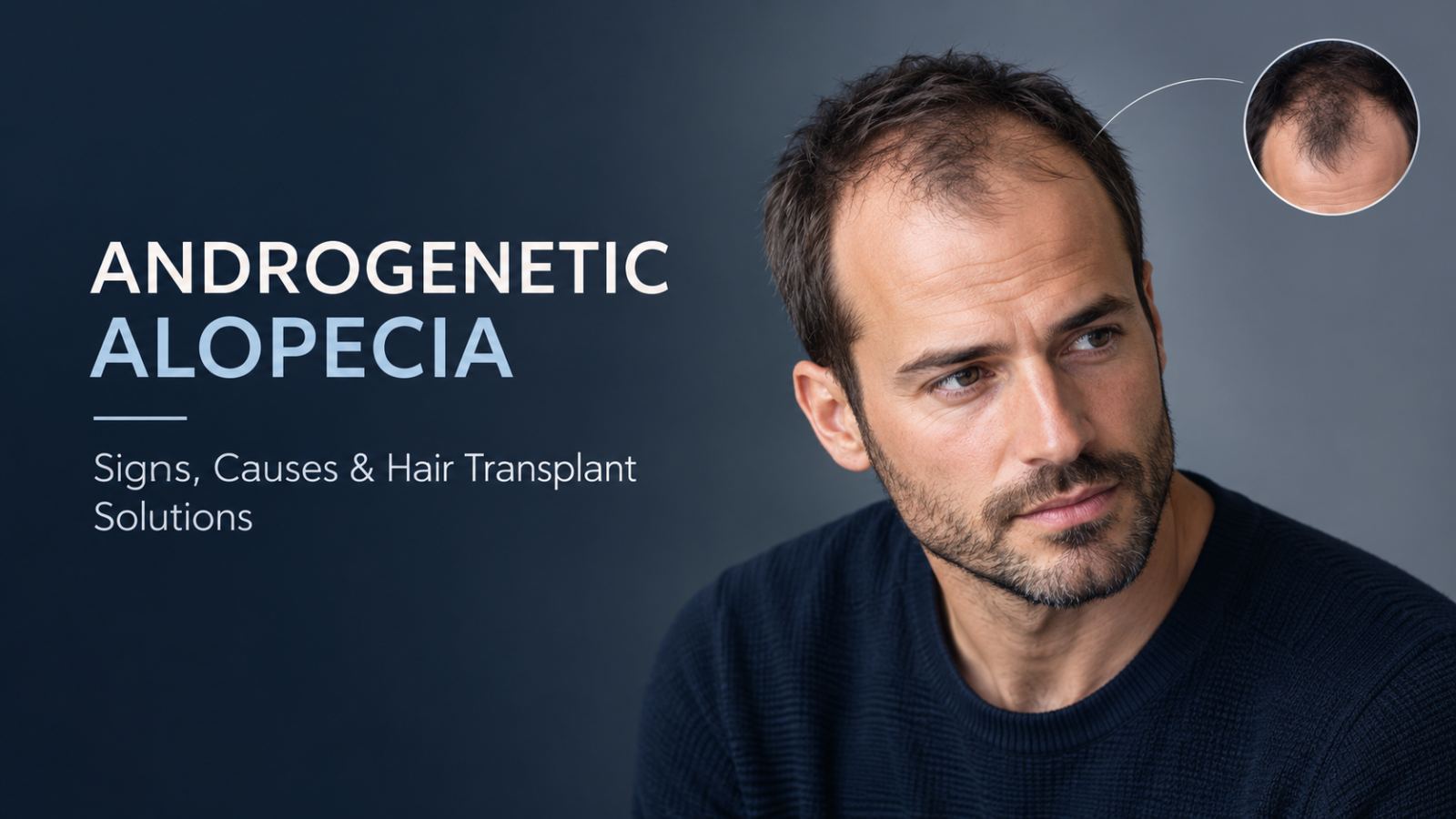
Androgenetic alopecia progresses gradually and can begin with a simple loss of density. Find out how to recognize the first signs and which solutions to consider.
What Exactly Is Androgenetic Alopecia?
Seeing a few hairs fall out in the shower or on your pillow is usually normal. However, when density gradually decreases, the hairline recedes, or the top of the scalp becomes more visible, it may be genuine hair loss.
Among the different forms of alopecia, androgenetic alopecia is one of the most common. It affects both men and women, although its progression and pattern can differ.
In men, it often appears as a gradually receding hairline, a loss of density at the temples, or thinning at the crown. In women, the loss of density tends to be more diffuse, notably with a progressively widening part.
This does not necessarily mean the hair will fall out suddenly. On the contrary, progression is often slow. Hair may first become finer, grow for a shorter time, and gradually lose volume.
This is precisely why it is worthwhile to recognize the first changes rather than wait until a completely bald area appears.
Why Does Hair Gradually Become Thinner?
To understand androgenetic alopecia, we need to look at what happens at the level of the hair follicle.
Each hair grows from a follicle located in the scalp. In certain forms of hereditary hair loss, follicles sensitive to androgens gradually miniaturize. The hair they produce becomes finer, and its growth phase may shorten.
Over time, this miniaturization can change the overall appearance of the hair.
A patient may feel that their hair is "falling out more and more," when part of the problem is actually that new hairs are finer and less visible.
Genetics plays an important role. Family history can therefore provide clues, but it cannot on its own determine precisely how hair loss will progress in a given person.
Follicle Miniaturization: A Gradual Process
A follicle affected by androgenetic alopecia does not necessarily disappear immediately. It may produce hairs of progressively smaller diameter.
This is why some people first notice:
- thinner hair;
- density that seems to be decreasing;
- more visible scalp under certain lighting;
- a slightly different hairline;
- a less voluminous ponytail in women;
- more receded temples in men.
These signs can remain subtle for several years.
The American Academy of Dermatology notes that hereditary hair loss can affect both men and women, and that the first signs often differ depending on sex. In men, a receding hairline or a thinning area at the crown is common; in women, overall thinning or a widening part may be the first visible signs.
How to Recognize the First Signs in Men
In men, androgenetic alopecia often follows a fairly recognizable pattern.
The first change may appear at the temples. The hairline begins to lose its original shape and gradually becomes higher at the sides.
In other cases, the first visible change is at the vertex, the upper back part of the head. The hair becomes less dense and the scalp shows more when light hits the head directly.
It is also possible for both phenomena to appear at the same time.
Receding Temples
A slight recession of the hairline does not automatically mean that baldness is progressing. The natural shape of the hairline varies greatly from one person to another.
What deserves more attention is a progressive change: a hairline that recedes over several months or years, combined with a decrease in density around the temples.
The Crown Becomes More Visible
The second classic sign concerns the vertex.
At first, the difference can be hard to notice. Some people only discover it when they see a photo taken from above or under strong light.
Regularly comparing photographs taken under similar conditions can be more useful than checking your hair several times a day in the mirror.
What About Women?
Hair loss in women can have many causes and should not automatically be attributed to androgenetic alopecia.
When it is the cause, the loss of density is often diffuse. The part may gradually appear wider, and the overall volume of the hair may decrease.
Hair worn up may also seem less thick than before.
However, diffuse shedding can be linked to other situations: significant stress, recent illness, major weight loss, pregnancy, hormonal disorders, deficiencies, or certain medications.
The American Academy of Dermatology emphasizes that hair loss can have many causes and that identifying the cause is an essential step before choosing a treatment.
Hair Shedding or Hair Thinning: What's the Difference?
This distinction is important.
Losing a few dozen hairs a day can be part of the normal hair cycle. The American Academy of Dermatology indicates that a daily loss of about 50 to 100 hairs can be normal.
The problem arises when overall density decreases or when regrowth no longer sufficiently compensates for the hairs lost.
It is also necessary to distinguish temporary excessive shedding from progressive alopecia.
After an illness, surgery, childbirth, a period of significant stress, or marked weight loss, a person may notice heavier shedding a few months after the triggering event. This situation can sometimes be temporary.
By contrast, androgenetic alopecia generally progresses more gradually.
This is why counting every lost hair is not necessarily the best way to monitor your situation. The evolution of density, the pattern of loss, and the appearance of the scalp are far more informative.
Can the Progression of Alopecia Be Slowed?
In many cases, early management makes it possible to better control hair loss.
The choice, however, depends on the cause, age, sex, extent of the loss, and condition of the scalp.
There is no single solution that works the same way for everyone.
Before choosing a treatment, it is therefore preferable to determine what is actually causing the hair loss.
Medical Treatments
Certain medications may be proposed for some forms of alopecia.
Minoxidil, for example, is used in certain situations of hereditary hair loss. The American Academy of Dermatology indicates that it may help stimulate growth and slow loss in some people, but that results take time and that treatment generally needs to be continued to maintain its benefits.
In some men with androgenetic alopecia, the doctor may also consider other prescription treatments, depending on the patient's profile and any contraindications.
These treatments should not be started at random. A medical consultation can determine whether they are truly suited to the situation.
Are Vitamins and Supplements Always Necessary?
This is a very common question.
Faced with hair loss, some people immediately start taking zinc, vitamin D, biotin, iron, or various "hair-specific" supplements.
However, a dietary supplement is not automatically useful simply because hair is falling out.
A balanced diet remains important, but supplementation should primarily address an identified need. The American Academy of Dermatology also points out that an excess of certain nutrients can itself be associated with problems, which makes self-medicating with several supplements unwise.
When a deficiency or abnormality is suspected, a healthcare professional can decide whether a blood test is necessary.
You can also read our guide on hair loss, tests and available solutions.
Which Daily Habits Can Protect Your Hair?
Even when the main cause is genetic, certain habits can limit additional stress on the hair fiber and scalp.
Avoid Overly Tight Hairstyles
Hairstyles that put repeated traction on the hair can cause a type of hair loss called traction alopecia.
Very tight ponytails, strongly pulled braids, or certain extensions can exert significant tension when used frequently.
Limit Repeated Damage
Chemical treatments, certain hair colors, perms, and excessive heat can weaken the hair fiber.
They are not necessarily responsible for all hair loss, but already fragile hair deserves a gentler routine.
Take Care of Your Scalp
A clean, properly maintained scalp is an important foundation for good hair hygiene.
It is not necessary, however, to multiply products or use harsh treatments. A suitable shampoo and a regular routine are generally more beneficial than an accumulation of "anti-hair-loss" products.
When Should You See a Doctor About Hair Loss?
You do not need to wait for advanced baldness to seek professional advice.
A consultation may be appropriate when:
- hair loss is becoming progressively heavier;
- the hairline is changing quickly;
- the crown is becoming more visible;
- the part is widening;
- bald patches appear;
- the scalp shows redness, itching, or pain;
- the shedding begins after an illness or a major change;
- several family members experience early hair loss.
The doctor can examine the scalp, look for characteristic signs, and, depending on the situation, request tests or other examinations. Mayo Clinic notes that the evaluation may include a physical exam, a review of medical history, and, when necessary, blood tests or a scalp biopsy.
The NHS also recommends finding the cause of hair loss before turning to a specialized commercial clinic.
When Should You Consider a Hair Transplant?
A hair transplant is not necessarily the first step for someone who is starting to lose their hair.
When the loss is recent, a medical evaluation can determine whether it can be stabilized or treated in another way.
However, when an area shows significant and lasting loss of density, particularly in the context of androgenetic alopecia, transplantation can become an option to discuss.
The goal is not simply to fill an empty area.
A well-planned transplant must take into account:
- the density of the donor area;
- the shape of the hairline;
- the patient's age;
- the likely progression of hair loss;
- the number of grafts available;
- the desired density;
- the natural direction of hair growth.
An overly aggressive hairline design can, in particular, needlessly use up part of the donor area's reserve.
FUE or DHI: Which Technique for Androgenetic Alopecia?
The technique used depends on the case and the implantation plan.
FUE (Follicular Unit Extraction) involves extracting follicular units individually from the donor area before implanting them in the recipient area.
DHI (Direct Hair Implantation) uses an implanter pen that allows follicles to be placed according to the protocol defined by the medical team.
At Estbody, the technique is chosen based on the analysis of the scalp, the area to be treated, and the desired outcome. The page dedicated to hair transplantation at Estbody presents the available methods in more detail.
It is therefore best not to choose a technique solely because it is presented as "the most modern." A technique that is right for one patient may not be right for another.
Why Is the Donor Area So Important?
When talking about hair transplants, attention often focuses on the balding area.
Yet the donor area plays a central role.
The follicles used for transplantation must be harvested from an area that is sufficiently dense and compatible with the patient's project. The quantity available is not unlimited.
A good strategy is therefore to think long term.
In a young person with progressive hair loss, it is particularly important to avoid treating only the problem that is visible today without considering how it may evolve in the following years.
This is one of the reasons why a personalized consultation is important before determining the number of grafts or the shape of the future hairline.
How Long Does It Take to See the Result of a Transplant?
A hair transplant does not produce a definitive change immediately after the procedure.
The first weeks are mainly devoted to healing.
A temporary shedding of the transplanted hairs may then occur. This phase can be unsettling for the patient, but it does not necessarily mean the transplant has failed.
Regrowth becomes progressively more visible over the following months. The result then continues to evolve for several more months.
On the page dedicated to hair transplants in Turkey, Estbody describes a gradual evolution of results and post-operative support designed to follow this period.
For this reason, comparing your result with someone else's after only a few weeks generally doesn't make much sense.
Can You Have a Transplant If Hair Loss Is Still Progressing?
This is an essential question.
A transplant does not necessarily stop the progression of loss in non-transplanted hair.
A person may therefore have an excellent implantation in a given area and continue to lose some of their natural hair around that area over time.
The project must therefore be designed for the long term.
In a patient with active androgenetic alopecia, assessing how the loss is likely to progress is particularly important before defining the transplant strategy.
This avoids focusing solely on the immediate result and allows you to consider the overall balance of the hair in the years to come.
Can Baldness Be Completely Prevented?
There is no method that can guarantee a person will never develop androgenetic alopecia.
Genetics and follicle sensitivity play an important role.
However, recognizing changes early makes it possible to get professional advice sooner and to explore the different options available.
A changing hairline, decreasing density, or hair that becomes progressively finer deserves more attention than a single day when you notice more hair in your brush.
The goal is not to panic at every lost hair, but to learn to recognize a trend.
How to Actually Track Your Hair's Progress
The best way to track a gradual change is to take comparable photos.
Try to keep:
- the same lighting;
- the same distance;
- the same angle;
- a similar hairstyle;
- photos of the front, sides, and top.
A photo taken every few months can be far more informative than daily observation.
This method can also help the healthcare professional understand how the problem has evolved during a consultation.
Signs That Deserve Particular Attention
Not all hair loss looks the same.
Gradual loss at the temples or crown may suggest androgenetic alopecia, whereas sudden, diffuse shedding may have another origin.
Distinct bald patches, significant itching, pain, redness, or unusual changes in the scalp also warrant medical advice.
The right question is therefore not simply: "How many hairs am I losing?"
You should also ask:
"How is my density changing, and why?"
It is this distinction that helps avoid choosing a treatment at random.
Why Does a Personalized Diagnosis Change the Approach?
Two people can have hair loss that looks similar while having different causes.
One may have progressive androgenetic alopecia. Another may have temporary shedding after a period of stress or illness. A third may have several combined factors.
Treatment then depends on the diagnosis.
The American Academy of Dermatology insists on this point: because the causes of hair loss are numerous, identifying the cause is essential to choosing appropriate care.
This is also why a shampoo or dietary supplement presented as a universal solution cannot address every situation.
Preparing a Hair Transplant Project in Turkey
When a transplant becomes a viable option, the choice of clinic should not be limited to the advertised price.
It is helpful to check several things:
1. Diagnosis Before the Procedure
The consultation should assess the nature of the hair loss, the donor area, and the recipient area.
2. The Implantation Plan
The hairline must suit the patient's face and age, while taking the available reserve into account.
3. The Proposed Technique
FUE, DHI, or another approach: the technique should match the medical plan and not simply a marketing trend.
4. Follow-Up After the Procedure
The first weeks and months after the procedure are an integral part of the journey.
At Estbody in Istanbul, support includes organizing your stay, the consultation, the procedure, and post-operative follow-up.
FAQ – Androgenetic Alopecia and Hair Loss
Does androgenetic alopecia affect only men?
No. It can also affect women. However, the pattern and appearance of the loss are often different.
How do I know if my hair loss is genetic?
Gradual progression, family history, and a characteristic pattern of loss can point toward a diagnosis, but only a professional can confirm the cause.
Is it normal to lose hair every day?
Yes. A certain amount of hair falls out naturally every day. The AAD indicates that a loss of about 50 to 100 hairs per day can be normal.
Can thin hair become thicker again?
It depends on the cause. In some forms of hair loss, treatment can improve density or slow progression. A prior evaluation is preferable.
Can dietary supplements stop baldness?
They are not a universal solution. Supplementation can be relevant when a nutritional need has been identified, but it does not replace diagnosing the cause of hair loss.
Does minoxidil work for everyone?
No. It can help some people with certain forms of hair loss, but results vary and the treatment should be used according to medical recommendations.
When should I consider a transplant?
A transplant can be considered when the loss is lasting, the donor area is sufficient, and the patient has an indication compatible with transplantation. A prior diagnosis is essential.
FUE or DHI: which should I choose?
There is no technique universally suited to all patients. The choice depends notably on the area to be treated, the desired density, the donor area, and the implantation plan.
Does a transplant prevent natural hair from falling out?
No. Transplanted hair and existing natural hair must be considered separately. Loss of non-transplanted hair may continue to progress depending on the underlying cause.
How long should I wait before judging the result of a transplant?
Regrowth is gradual. The first weeks generally do not allow you to judge the final result. Progress continues for several months.
Recognize Early to Choose the Next Step Better
Androgenetic alopecia does not always begin with a completely bald area. It can set in gradually, sometimes over several years, with hair that first becomes finer and density that slowly decreases.
This is why the first reflex should not be to immediately look for a miracle solution.
Observing the progression, identifying the cause, and getting appropriate advice make it possible to better understand the situation. Depending on the diagnosis, different possibilities can then be considered: simple monitoring, medical treatment, correction of a possible deficiency, or, when indicated, a hair transplant project.
If a transplant is being considered, Estbody supports international patients in their hair transplant project in Turkey, in Istanbul, with a personalized evaluation before the procedure and follow-up afterward.